Facing a Challenging Operating Environment
Facing a Challenging Operating Environment
Too often, we view challenges as burdens—obstacles that drain energy, disrupt progress, and introduce uncertainty. However, an alternative outlook sees these hurdles as opportunities for improvement, motivating creative problem-solving and resilience.
The choice is yours. Instead of thinking, "This is too hard," the mindset must become: "This is how I grow."
The legal profession, particularly small- and midsize firms, is navigating serious challenges such as rising costs, shifting client expectations, talent pressures, and uneven technology adoption. While not every firm feels the same pressure, many are currently grappling with the following challenges.
1. Client Acquisition & Retention
Small firms face intense competition from larger firms and alternative legal services providers (ALSPs) with bigger marketing budgets and stronger brand recognition.
Key Challenges
● Brand Equity: Harder to stand out without established brand equity.
● Lead Generation: Heavy reliance on referrals and local visibility.
● Digital Expectations: Clients expect digital-first experiences, such as online intake and transparent pricing.
2. Maintaining Broad Expertise
Unlike large firms with deep specialization, small firms often cover multiple practice areas to remain viable.
Key Challenges
● Domain Fluency: Staying current across diverse legal domains.
● Complexity: Handling intricate matters without internal specialists.
● Burnout: Risk of burnout and errors due to overextension.
3. Rising Costs vs. Rate Pressure
Mid-sized firms must balance raising rates while maintaining a cost advantage over larger competitors. Expenses are rising faster than growth rates for many firms.
Key Challenges
● Material Investments: High costs for technology and talent compensation.
● Real Estate: Office space and distributed operations.
● Compliance: Increasing costs for insurance and regulatory adherence.
4. Billing & Collections Inefficiencies
While mid-sized firms excel at generating billable work, many struggle to collect it efficiently. Median collection times are rising, locking up significant cash flow.
Key Challenges
● High Lockup: Significant revenue is trapped in unbilled and uncollected states.
● Cash Flow: Over-reliance on credit lines to manage cash flow.
5. Technology Adoption Gaps
Both small and mid-sized firms remain cautious about AI and tech adoption, even as clients become more open to these tools.
Key Challenges
● Lost Efficiency Gains: Slower research and drafting processes equals lost efficiency gains
● Inconsistency: A lack of standardized tech may lead to a fragmented client experience.
● Competitive disadvantage vs. tech-forward firms: as more firms adopt AI and other technology tools tech-forward firms gain a competitive advantage
6. Talent Recruitment & Retention
Smaller firms often struggle to compete with the compensation packages and career paths offered by larger firms
Key Challenges
● Specialist Scarcity: Difficulty attracting niche experts.
● Turnover: Increased workload for remaining staff when talent leaves and ongoing recruitment
7. Geographic Expansion & Market Reach
Mid-sized firms are shifting toward a distributed "retail-style" model—a central hub with satellite offices—to stay close to clients.
Key Challenges
● Operational Complexity: Managing brand coherence and service across multiple locations.
● Systems Integration: The difficulty of centralizing systems while decentralizing physical presence.
8. Strategic Planning & KPI Management
Many firms lack the data infrastructure to effectively track performance.
Key Challenges
● Key Performance Indicators: No standardized metrics tied to firm goals and strategy.
● Data Hygiene: Lack of standards around data inputs making outputs unreliable (“garbage in-garbage out”).
● Visibility: Limited insight into profitability by matter, client, or lawyer.
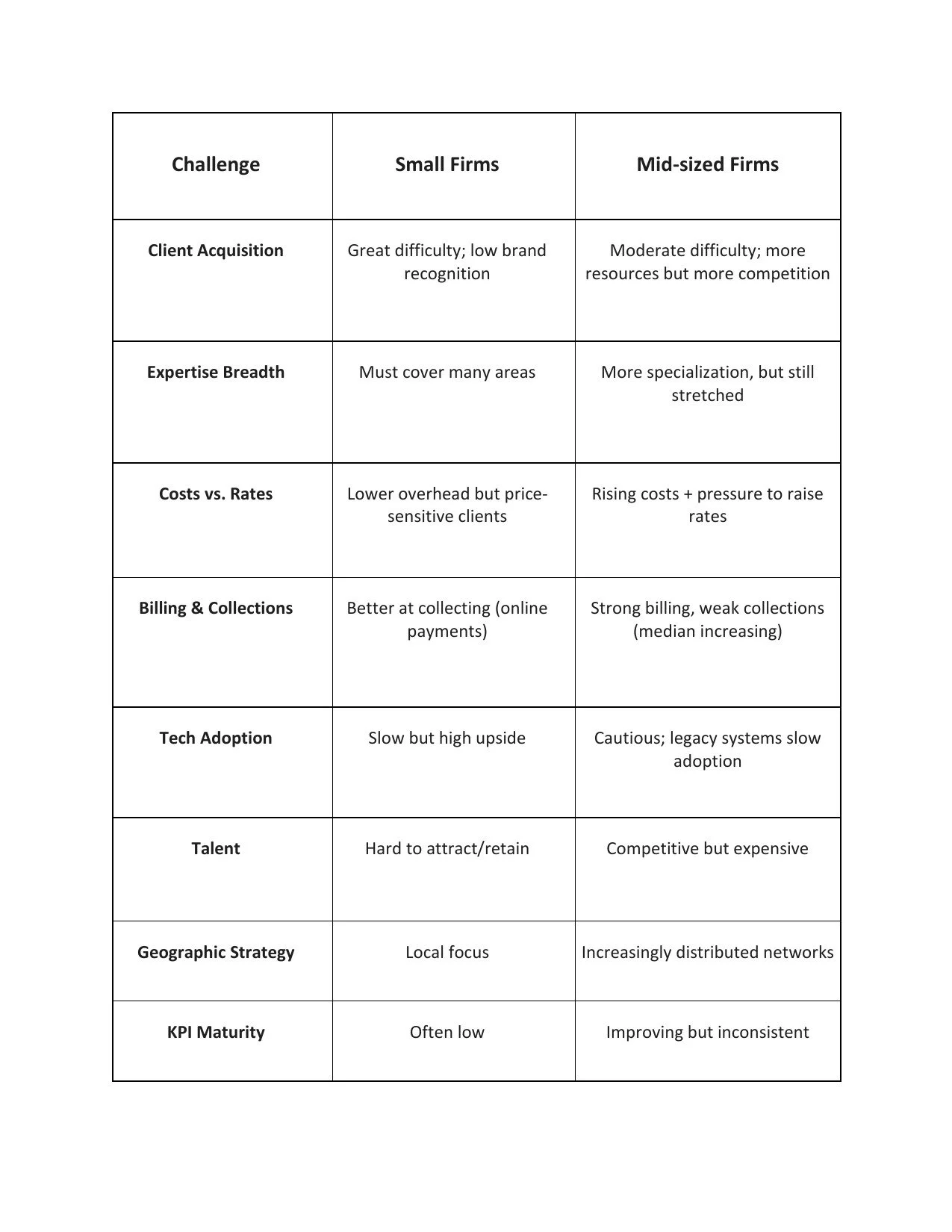
Comparison: Small vs. Mid-sized Firms
To embrace effective solutions to these and other challenges requires not only a positive attitude toward challenges but also critical decision-making that is pro-active rather than reactive. The extent of these challenges varies based on firm size.
The following table highlights the difficulty levels for each:
"Problem-solving leaders have one thing in common: a faith that there's always a better way."
— Gerald M. Weinberg
Who is East Coast Legal Ops?
We are a partnership of Atlantic Canadian professionals focused on bringing together the people who support the business of law:
● Terry Moore, BComm, ICD.D (Moore for Professionals Strategy + Marketing)
● Stephen Mabey, CPA, CA (Applied Strategies Inc.)
● Elaine MacEachern, CITP (International Legal Reform Consultant – Finance)
We deliver this support via conferences, private presentations, and insightful articles. At the same time, we remain active in our professional consulting practices. In the spring of 2026, we will publish a booklet titled Key Performance Indicators for Your Legal Practice: Measuring Success and Driving Growth, which will include many of the new data sets that firms are turning to.
Upcoming Initiatives
● Spring 2026 Publication: Key Performance Indicators for Your Legal Practice: Measuring Success and Driving Growth.
● Annual Conference: The 2026 East Coast Legal Ops Conference is scheduled for September 23rd & 24th, 2026. This forum is designed for legal operations professionals, senior administrators, COOs, and lawyers involved in the business of law.
Contact Us: info@eastcoastlegalops.ca
